Item : 326472
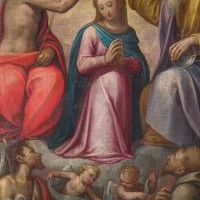
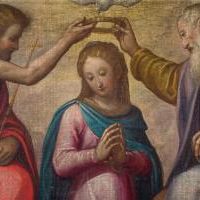
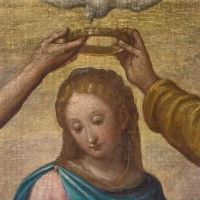
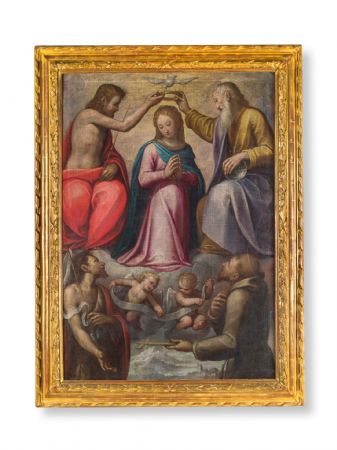
Guglielmo Caccia known as il Moncalvo (Montabone 1568 – Moncalvo 1625), Coronation of the Virgin SOLD
Author : Guglielmo Caccia detto il Moncalvo
Period: 16th century
Guglielmo Caccia known as il Moncalvo
(Montabone 1568 – Moncalvo 1625)
Coronation of the Virgin
16th century
Oil on canvas, 116 x 82.5 cm
CACCIA, Guglielmo, known as il Moncalvo. – Son of Giovanni Battista and a Margherita, his date of birth in Montabone (Acqui) is not confirmed by any document, but the one (1568) reported by Orlandi as early as 1704 seems trustworthy, also considering that C.'s first works, in Guarene, are from 1585, and that his marriage to Laura Oliva, daughter of the painter Ambrogio Oliva, took place on November 6, 1589. The altarpiece of the Annunciation at the Annunciata in Guarene and the Madonna and Saints in S. Michele, also in the same location, confirm what could already be suspected based on the marriage acts: C. began his career as a painter in the modest artistic environment of Casale. Later, around 1590, coinciding with the first works at the Sacro Monte di Crea (chapel of the Presentation of the Virgin at the Temple), he shows to have shifted his attention towards the Vercelli school, and this stylistic update will become even more evident in the works dated or datable to 1593. In April falls the Crucifixion of the parish church of Calliano, in July the fresco decoration of the chapel of the Rosary in S. Michele in Candia Lomellina (under the patronage of the noble Confalonieri family), and in succession should be placed the decoration of the chapel of the Nativity of the Virgin at the Sacro Monte di Crea, commissioned by Vincenzo I Gonzaga and completed precisely in 1593. From the same year, or slightly later, one can consider the canvas with a Franciscan Allegory in S. Francesco in Moncalvo, iconographically derived from an engraving by Agostino Carracci. On December 10, 1593, C. bought a house in Moncalvo, and this is the first sure indication of his transfer to the center from which the fortunate nickname would derive. The altarpiece dated 1595 of the parish church of Grana (Madonna and Child, saints, and two donors from the De Alessi family) indicates a further development of the Cacciana style probably determined by a trip to Bologna to see the early works of the Carraccis: the colors have become more transparent and the ranges more subtly graduated; even the persuasiveness of feelings knows a new deepening. The success of this unprecedented manner for Piedmont is documented, the following year, by the act of commission for an altarpiece destined for Larizzate (now lost) from which it appears that the artist was considered far superior to the heirs of the workshop of Bernardino Lanino; lost is also a S. Rocco, dated 1599, formerly kept in the sacristy of S. Francesco in Moncalvo. Since the date MDC affixed belatedly to the Madonna of the Rosary of the parish church of Solero Alessandrino is false, it is necessary to reach the altarpieces of the parish church of Cioccaro (Madonna, Saints, and donors; Madonna of the Rosary) to identify C. again in works that are certainly dated (1602): they are two canvases that stand on the line of the new devout naturalness, already followed in the altarpiece of Grana, developing its principles also with direct support to G. Ferrari and perhaps to the young Cerano. For the following years, after 1602 until 1606, the chronology suffers from some oscillation due to various confusions, ancient and modern, regarding dates, documents, and dubious works. Fixed points of absolute certainty could have been the S. Giovanni Battista, frescoed in 1603 in S. Giovanni in Moncalvo, and the Madonna and Child on the facade of a private house in Chieri (via Tana, 22), which bears the date 1605; unfortunately, the first is severely disfigured by a restoration of 1713 and the second is only partially legible due to the damage suffered. The private documents of these years tell us that in 1602 and in 1604 C. buys properties and carries out financial transactions in Moncalvo, but already in 1605 we find registered a payment for works carried out in Turin, in the palace of the Viboccone now destroyed. It is only the first of a long series of Turinese payments that will last throughout 1606 and 1607 and will end only in June 1608. Excluding the payment of 1605, all the others refer to work in the current Palazzo Madama and the decoration of the large gallery wanted by Carlo Emanuele I to unite Palazzo Madama itself to the new ducal palace. The design of the gallery had been defined by F. Zuccari in October 1605, but it should be noted that for the sum of money received and for certain statements of the documents C. did not act only as a collaborator in subordinate position, but as co-star, and was then able to complete the work after the departure of Zuccari himself (before the end of 1607). Nothing remains of the gallery, if not perhaps a drawing now at the Royal Library of Turin (cat. Bertini, 1958, n. 262), but the coincidences with the ancient descriptions, the characteristics of style still identifiable in the Madonna of 1605 in Chieri and certain recognizable relationships with the latest production of Zuccari in Rome, allow the composition of a homogeneous group of works to be placed in the years of Caccia's stay in Turin. First of all, the vault of casa Tizzoni in Vercelli frescoed with mythological themes very close to those described in the palace of the Viboccone should be mentioned. Similar to these frescoes are the Nativity of the Baptist in the Confraternity of S. Giovanni in Casalcermelli (signed and of which there remains a drawing in Brera, n. 7/126), the Nativity of the Virgin frescoed already in the convent of the Misericordia in Cuneo and now in the local Cassa di Risparmio, the Immaculate Conception in S. Francesco in Acqui and the Christ nailed to the cross in S. Bernardino in Vercelli. Immediately follow the Madonna of the Rosary of the parish church of Pontestura (dated 1606), the S. Francesco in front of the Crucifix in S. Pietro in Villanova d'Asti (dated 1608), the lunettes with Stories of s. Nicola da Tolentino at the Civic Museum of Casale Monferrato (1607?) and two drawings with Stories of the childhood of S. Francesco at the Royal Library of Turin (cat. Bertini, nn. 249, 250), to be connected with another cycle of Casale remembered confusedly by the sources. After 1608 the terms of reference for the biography of C., returned to Moncalvo, become even more uncertain due to the absolute lack of dated or datable works and the enormous expansion of his activity. Some concrete support is found only after 1613, because we can document that the chapel of S. Carlo Borromeo in S. Marco in Novara and the choir of this same church were completed between October 1613 and April 1615, while the works in the choir of S. Domenico in Chieri follow closely, between 1615 and 1616. Between 1608 and 1613 one could try to place the most famous paintings, which develop with greater certainty of drawing and chromatic richness the premises of the Zuccareresque works, but which already tend to formulate in acronym the manner Cacciana. It is about the S. Francesco of the parish church of Rosasco, the S. Rocco in S. Rocco in Moncalvo, the Martyrdom of s. Stefano in Testico, the Resurrection in the cathedral of Asti, the six large canvases in S. Michele in Casale Monferrato (two preparatory drawings in the Bibl. Reale of Turin, cat. Bertini, n. 252, and National Gallery of Edinburgh, n. 3161), the two Stories of s. Matteo in S. Paolo in Casale, the large altarpiece of the Rosary in S. Salvatore Monferrato and finally the altarpieces of S. Tommaso and S. Giacinto in Santa Croce in Boscomarengo. Together with the works of Chieri and Novara, and to further confirm the fortune of C., will still be remembered the Stories of the Virgin in the cathedral of Alessandria (excluding the Annunciation which is later) and a consistent group of works of private devotion, among which excel the Madonna and Child and S. Anna in S. Ilario in Casale, the analogous small canvas in the Pinacoteca Repossi in Chiari and the small Madonna and Child on copper of the Museum of the Castello Sforzesco in Milan. The large amount of work listed here and others of minor interest probably occupies C. also for 1616 and the first part of 1617, so that he will have to refuse, precisely in 1616, invitations to work at the Sacri Monti of Varallo and Orta. At the end of 1617 we know that he is in Milan, where, on November 28, he gives receipt of "complete payment" for the works at the dome of S. Vittore al Corpo (the subsequent stucco decoration will be finished, in 1619; in the spandrels with the Evangelists is recognized the hand of the collaborator Daniele Crespi). The study of the Lombard activity has not yet been addressed in detail, but it is still possible to provide some other indications, in addition to those on S. Vittore. The frescoes in S. Pietro in Gessate (chapel of S. Bruno, in collaboration with Crespi) are immediately after 1617; the Adoration of the Magi in S. Alessandro already existed in 1619, when the dome of the church collapsed, partially damaging it; the presence in Monza of the artist is remembered in 1619 by Borsieri, and the Decollation of the Baptist in the duomo and the canvases already in S. Agata and now in S. Maria al Corrobiolo are probably immediately prior. On December 24, 1618, S. Anna al Carmine in Pavia was already finished and in 1619 the decoration of the chapel of S. Lucia in S. Michele, also in Pavia, was concluded, which includes an altarpiece with the Martyrdom of the saint by the hand of Caccia. By stylistic comparisons, other Milanese works on which it has not been possible to find documentary indications should also be linked to these paintings: the two canvases with S.Pietro and S.Francesco in the church of SS. Paolo e Barnaba, the decoration with canvases and frescoes of the sacristy of S. Alessandro (for the Annunciation there is a preparatory drawing in Palazzo Rosso in Genoa, n. A 1237), the three canvases with S. Gerolamo, Christ and the Virgin of the Tribunal of Provvisione, now at the Museo del Castello Sforzesco, the decoration with canvases and frescoes of the transept and choir of S. Antonio Abate. Furthermore, the Martyrdom of S. Orsola in S. Orsola in Como and the decoration with canvases and frescoes of the interior of S. Maria di Canepanova in Pavia require a mention (preparatory drawing for two Sibyls in coll. priv. piemontese). Continuing in chronological order, the Madonna of the Rosary in the cathedral of Valenza Po can follow, among other works, executed in Pavia and placed on its altar In February 1620, the Deposition in S. Gaudenzio in Novara, also already completed in 1620. The Milanese moment leaves a deep mark on C. who, in contact with the triumphant culture of Cerano, Morazzone, Procaccini, strives to align on the front of formal elegance and late-mannerist executive refinement. For the last phase of C.'s activity, after returning to his homeland towards the end of 1619, it is better to limit ourselves to pointing out a few certain paintings, since most of the later works show extensive interventions by his daughter Orsola Maddalena. Furthermore, likely suspensions of activity due to serious illnesses should be taken into account, as would be evidenced by the two wills of November 8, 1620, and August 29, 1622 (see Negri, 1896, pp. 117-119). The Conversion of St. Paul in St. Paul in Casale, to which the two versions of the theme of St. Michaels are connected, is still very close to the Madonna del Rosario in Valenza, conserved at S. Salvatore Monferrato (hospital church) and at Mortara (Santa Croce). The term ante quem could be the Martyrdom of S. Maurizio in the church of the Capuchins in Turin, which cannot be far from 1623, the date of the painting that stands in front of it, painted by Cerano. Immediately after should be aligned the canvases that indicate the transition from the precious Milanese ranges to those, smoky, of the very last years: the Tobit and the angel of the cathedral of Tortona, the four Virtues of the cathedral of Casalmaggiore, the Annunciation in the cathedral of Alessandria (where the preparatory drawing is also conserved), the Adoration of the Magi to the Brotherhood of Merchants of Turin, the Wedding at Cana in the civil hospital of Alessandria (see F. Gasparolo, Un quadro del Vermiglio, in Rivista di storia… prov. di Alessandria, XXXIII [1923], p. 335). To 1624, year suggested by the sources (see Moccagatta, 1962-63, p. 62), may date the Martyrdom of s. Paolo in S. Paolo in Casale Monferrato, while the Transverberation of s. Teresa in S. Teresa in Turin and the S. Francesca Romana in the church of the Madonna in Moncalvo belong to the following year. Both of these canvases are remembered as already finished in the will of November 5, 1625 (Negri, 1896, pp. 120-122), which also mentions the Martyrdom of s. Maurizio, now in S. Francesco in Moncalvo, as an unfinished work and entrusted to his daughter Orsola Maddalena for the necessary completion. C.'s death is recorded in the parish books of Moncalvo on November 13, 1625 (ibid., p. 125)
SOLD