Item : 330589
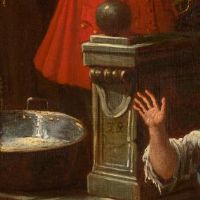
Giovanni Michele Graneri (Turin 1708 - 1762), Saint Felix of Cantalice, Distributing Soup to the Poor SOLD
Author : Giovanni Michele Graneri (Torino 1708 - 1762)
Period: 18th century
Giovanni Michele Graneri
(Turin 1708 - 1762)
Saint Felix of Cantalice, Distributing Soup to the Poor
Oil on canvas
120 x 90 cm
GRANERI, Giovanni Michele. - This painter, active in Piedmont in the mid-18th century, is probably identifiable with Giovanni Michele Graneri, son of Giovanni Maria, a "fabric worker," and Clara Maria Andriola of Turin, born in Turin on September 28, 1708, and baptized in the church of Sts. Simon and Jude on September 30. Eighteenth-century sources say he was a student of Pietro Domenico Olivero, the most important and famous genre scene painter in Turin, and G.'s early paintings are strongly influenced by him both in the overall layout and in the rendering of the figures. Like Olivero, G. also fits into the trend of bamboccianti painting, which had been known in Turin through the work of Jan Miel in the mid-17th century and through the paintings of other Flemish painters present in the Savoy collections. In 1736, G. received a payment from the court for painting "rasi 50 bindello picolo in the form of livera to adorn seven suits of picole figures for the entertainment of the Royal Infants" (Schede Vesme, p. 539). This is the only information about G.'s activity as a painter on fabric. The first dated and signed works by G. are from 1738, four canvases with typical genre scenes: a Brawl, a Charlatan with acrobats, a Seller of Cheese, and a Seller of Sausages and Meats. The paintings, known today only through black and white photographs, belonged to the Pietro Accorsi gallery in Turin. Dating to 1740 is the Market in Piazza del Municipio, a canvas also known as The Punishment of Rotten Egg Sellers (Turin, Museo Civico d'Arte Antica). It is an accurate description of a news event that vividly and meticulously testifies to daily life in Turin in the mid-18th century, with armed gendarmes, rich or popular clothes, signs, buildings, stalls with fruit and vegetables. The painter is concerned, in fact, with rendering the real vivacity of the event with bright colors and amusing details, without dwelling too much on the physiognomies of the figures, which are similar to each other. Unlike Olivero, G. does not want to meditate on the human events he describes, but to have fun and render with irony the life that flows around him, sometimes exasperating certain aspects to the point of their deformation. In The Tooth Puller, signed and dated 1743, G. constructs a small theatre in which the protagonist, dressed in red, triumphantly shows the extracted tooth, the patient responds to the pain by raising his arm, while the tooth puller's assistant looks with admiration and curiosity through the mask that covers his face. In the foreground, to the right and left, are groups of figures, which are found in other paintings by G., almost fixed presences on the scene, and in the background other images of vendors under a portico; the painter's signature is placed on a painting hanging on a wall, which illustrates a man tinkering with vials and alembics. The same figure is found in other paintings, almost an emblem of a game of mirrors and disguises. Pendant is The Storyteller or The Horse of the Pots (Turin, Museo Civico d'Arte Antica), in which a young storyteller, accompanying himself with a musical instrument, tells the story illustrated on the board hanging on the wall; while a horse loaded with pots is on the ground, fallen disastrously along with its burden amidst the dismay of the driver. On the left, in the foreground, two people are de-lousing each other, indifferent to what has happened, like the young man next to them, kneeling with dirty feet facing the spectators, almost a cultured quotation. On August 21, 1747, G. married Francesca Margherita Canicoschi of Turin in the parish of Sts. Martyrs Marco and Leonardo, with whom he had three sons and a daughter. Dating to the same year is a series of works on Sardinian subjects, commissioned by Minister Giovanni Battista Bogino for his villa on the Turin hill. G.'s canvases, now preserved at the Turin Civic Museum, are particular both for their large size and for the complexity of their spatial construction: they, in fact, have a vertical trend with a succession of perspective planes that is pressing and almost archaic in flavor. Deer Hunting in Sardinia, signed and dated, is perhaps the most successful for its vivacity in the rendering of the characters, distributed in the space to illustrate the various phases of the hunt; there are also scenes of banquets and celebrations with spits and bonfires, tables set under the shelter of field tents built for the occasion, men lying down from too much wine, children scurrying here and there, a lady with cicisbei. Feast at a Sardinian Sanctuary is a pretext for describing groups of people without distinction of class, engaged in various occupations. Nautical Feast in the Port of Cagliari is set on the sea with boats full of passengers; while in the background appears the city with its walls. The Tuna Fishing also belongs to the Sardinian series, although it is smaller in size. Bogino also commissioned G. canvases of Piedmontese subjects with markets and fairs, artisans, tooth pullers, taverns, brawls, storytellers. There are twenty-six canvases from the minister's villa preserved at the Civic Museum of Turin. Another compact group is that of the six canvases with the Story of the Prodigal Son, a theme of great success in Piedmont. G. takes up the work of Cornelius de Wael, adding color and attention to the described details (Cifani - Monetti, p. 340). Dating to 1752 is the Market with Comedians, which depicts a crowded square with the usual stalls, vendors, goods on display, and a procession with some masks heading towards a stage where a performance is already underway; here appears G.'s compositional maturity both in the lateral architectures built in planes degrading towards the background and in the definition of the groups of people harmoniously distributed among the objects on display with the care of Flemish still lifes. In those same years, G. painted a group of canvases with some well-recognizable Turin squares: Piazza S. Carlo (Turin, Museo Civico d'Arte Antica), Piazza del Mercato di Porta Palazzo (private collection), Piazza delle Erbe (Sarasota, Florida, John and Mable Ringling Museum of art). In these three great works, the juxtaposition between the architectures and the characters is perfect; there are also some elements taken from other paintings such as the horse on the ground loaded with pots, the butchered animal hanging for sale, the scuffle of the card players. Interesting is the correspondence between these architectures painted by G. and some famous engravings made in those years for the court. Perhaps these paintings were part of a larger series on the squares of Turin, a new way of exalting the power of the king or perhaps just a new path indicated by G. for the genre painting of Turin. G. is also known for paintings of sacred subjects: Encounter between St. Philip Neri and St. Felix of Cantalice against a background with the usual comedians and the crowd following (dated 1754: Asti, Museo Civico), Expulsion of the Merchants from the Temple and Wedding at Cana (dated 1756: ibid.) derived from famous models, as well as a large painting with the Preaching of St. Vincent Ferrer in Moncalieri (Cifani - Monetti, p. 342). G. is also attributed paintings of landscape; but the canvases known today are very rare (ibid., p. 343). G. died at the Boasso house in Turin on February 26, 1762, and was buried the following day in the church of S. Eusebio. Sources and Bibl.: G. Delogu, Pittori minori liguri, lombardi, piemontesi del Seicento e del Settecento, Venice 1931, pp. 242-246; A. Griseri, in Mostra del barocco piemontese. Pittura (catal.), Turin 1963, pp. 15, 104-107; L. Mallè, I dipinti del Museo d'arte antica, Turin 1963, pp. 93-101; A. Baudi di Vesme, Schede Vesme, II, Turin 1966, p. 539; A. Cifani - F. Monetti, I piaceri e le grazie, II, Turin 1993, pp. 335-343; S. Ghisotti, in Il tesoro della città (catal.), Turin 1996, p. 170. by Cristina Giudice - Dizionario Biografico degli Italiani - Volume 58 (2002) www.treccani.it
SOLD

.jpg&larg=200&alt=200)
.jpg&larg=200&alt=200)
.jpg&larg=600&alt=450)