Item : 410881
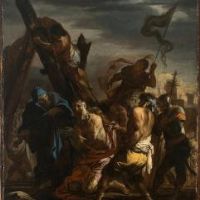
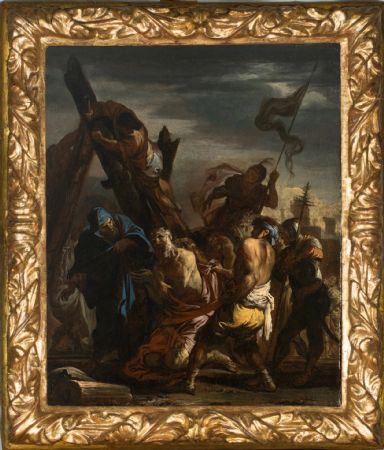
Pasquale Chiesa (Genoa, about 1625 - Rome, 1654) - Martyrdom of Saint Andrew
Author : Pasquale Chiesa (Genova, 1625 circa. - Roma, 1654)
Period: 17th century
Measures H x L x P
Height cm. : 48cm
Widht cm. : 38,5cm
Deep cm. : 3cm
Studies on the artistic personality of Pasquale Chiesa, completely forgotten before the critical recovery by Safarik and Andrea G. De Marchi', have seen a rapid acceleration in recent years. In fact, Luca Calenne deserves an important contribution where the scholar highlighted the painter's presence in the inventories of Pietro Paolo Avila, Antonio Barberini, Cavalier Petrucci and Paolo Falconieri, and identified the Genoese in a letter from Salvator Rosa addressed to the Pisan intellectual and collector Giovan Battista Ricciardi, who owned four or five paintings by the painter. Gianni Papi is then responsible for some important additions to his catalog', which are added to the works mentioned in the inventory of the assets of Camillo Phampili drawn up in 1650, identified by Safarik and De Marchi in a group of paintings of considerable quality still preserved at the Doria Pamphilij Gallery: a Sacrifice of Isaac, a Magdalene, an Hagar and the Angel, a Repentant Saint Peter, a Saint Paul the Hermit and a Saint Jerome, all of large dimensions, in addition to a series of landscapes in which Chiesa collaborates as a painter of figures with Gaspard Dughet, Jan
Baptiste Weenix, Jan van den Ende and Alexanders Coosemans.
To this starting nucleus have therefore been added a Kneeling Saint Jerome already at Jacques Leegenhoek in Paris and a Martyrdom of Saint Bartholomew (Madrid, Caylus), published as works by the Genoese by De
Marchi; a half-figure Saint Jerome already referred to Giacinto Brandi and returned to the Genoese by Francesco Petrucci; A Martyrdom of Saint Andrew preserved at Palazzo Barberini attributed by Luca Calenne and a Saint Sebastian and the Angel made known by Gianni Papi?. The same Papi is also responsible for the publication of two other versions of the Martyrdom of Saint Bartholomew Caylus (both known only in photography), of a Diogenes and of an Incredulity of Saint Thomas preserved at the Kunsthistorisches
Museum in Vienna, where it bore a reference to Paolo Finoglio®.
As we can see, Pasquale Chiesa's corpus is rapidly expanding today, and this small but important Martyrdom of Saint Andrew (Fig. 1) will also be returned to it. Far from the large formats to which the Genoese has accustomed us, as well as from the naturalistic power and fury that confirm the words of Sebastiano Resta, according to whom Pasquale was a "student" of Salvator Rosa and a "great imitator" of Ribera®, the pictorial rapidity of this test and the synthetic restitution of the forms allow us to consider the painting, with a certain security, a preparatory sketch for a larger composition; the only one to have re-emerged to date by the painter, if we exclude the beautiful drawing made known by Francesco Petrucci preparatory to the execution of the Martyrdom of Saint Bartholomew Caylus or one of the other
two versions.
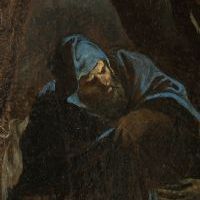
It is precisely a comparison with the latter that leaves no doubt about the reference to Chiesa: the same bearded old man in the center of the Spanish canvas, hooded and adorned with an electric blue dress (Fig.
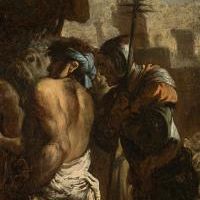
2), recurs to the left of the Martyrdom of Saint Andrew; moreover, the loaded and grotesque physiognomy of the soldier on the extreme right of the sketch is almost identical to that of the henchman at the vertex of the compositional triangle of the
Martyrdom of Saint Bartholomew (Figs. 3-4), or to that of the character depicted by Chiesa in a Landscape with still life preserved at the Doria Pamphilij Gallery and created by four hands with Alexander
Coosemans (Fig. 5).
A definitive confirmation is finally in the kneeling figure of Saint Andrew: it is identical, in counterpoint, to the beautiful Saint Jerome recently presented by Yuri Primarosa (Figs. 6-7)'°, where the dull red of the robe is the same; the same color we find in the Incredulity of Saint Thomas
of Vienna.
If, as already said, the relationship with Ribera takes a back seat here, also due to the speed of execution and the liquid painting that quickly describes the forms, it is on the other hand evident how much the lesson of Mattia Preti at Sant'Andrea della Valle and Lanfranco at San Giovanni dei Fiorentini (Figs. 8-9), as well as the predictable one of Salvator Rosa, played a key role in the development of this composition (think of the agitation of the movements and the atmospheric background landscape), whose final version, perhaps an altarpiece, has yet to be identified. It should, however, be remembered that a Martyrdom of Saint Andrew, presumably by Chiesa, belonged to Giovan Battista Ricciardi and was exhibited by his heirs, as Ribera, in 1706 and 1715 in the cloister of the Ss.ma Annunziata in Florence, together with a Saint Jerome and a "Saint Bartholomew martyred"'l: if it is possible that the canvas corresponds to the painting today at Palazzo Barberini, as proposed by Luca Calenne, it is equally plausible that the canvas that belonged to the Pisan collector has yet to re-emerge, and that the sketch presented here constitutes his first idea.
Tommaso Borgogelli
Colli al Metauro, 5 November 2023